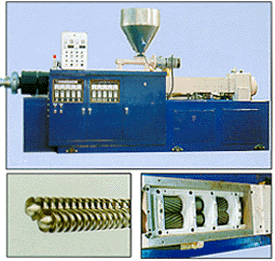
A Parallel-type Twin Screw Extruder
SYLLABUS FOR
Advanced Polymer Processing
Spring, 2004
Monday pm 3:00 - 5:50, classroom: the seminar room
Professor:
Dae Su Kim office)44-345 Tel)261-2371 e-mail: dskim@cbucc.chungbuk.ac.kr
Office Hours:
e-mail if possible, Tuesday pm 1-3
Textbook:
Polymer Processing by D. H. Morton-Jones, Chapman-Hall, 1989
References:
고분자공학 I by 김성철 외, 희중당, 1994
Polymer Processing by J. M. McKelvey, John Wiley & Sons, 1962
Fundamentals of Polymer Processing by S. Middleman, McGraw-Hill, 1977
An Introduction to Polymer Rheology and Processing by N. P. Cheremisinoff, CRC, 1993
Polymeric Materials and Processing by J. M. Charrier, Hanser, 1990
Plastic Processing by Radian Coorporation, Noyes, 1986
Engineering Rheology by R. I. Tanner, Oxford Univ. Press, 1989
Rheology: Principles, Measurements and Applications by C. W. Macosko, VCH, 1994
An Introduction to Rheology by H. A. Barnes et al., Elsevier, 1989
Analytical Polymer Rheology: Structure - Processing - Property Relationships by C. L. Rohn, Hanser, 1995
Rheology of Polymeric Systems: Principles and Applications by P. J. Carreau et al., Hanser, 1997
Lecture Schedule
1st week: Introduction to Polymers
2nd week: Properties of Polymers
3rd week: Introduction to Polymer Processing
4th week: Flow Behavior of Polymers
5th week: Mixing Technology
6th week: Mixing Machine
7th week: Extrusion
8th week: Analysis of Extrusion Process
9th week: Extrusion Based Processes
10th week: Properties of Extrusion Products
11th week: Blow Molding
12th week: Analysis of Blow Molding
13th week: Thermoforming
14th week: Principles of Injection Molding
15th week: Injection Molding Technology
Lecture Notes
Chap. 1 The Nature and Origin of Polymers
Chap. 2 Physical Basis of Polymer Processing
Chap. 3 Mixing Technology
Chap. 4 Extrusion
Chap. 5 Extrusion Based Processes
Chap. 6 Blow Molding
Chap. 7 Thermoforming
Chap. 8 Injection Molding
Chap. 9 Compression and Transfer Molding
Course Objectives:
1. To develop a fundamental understanding of polymer materials and processing technology.
2. To learn how to choose proper processing methods and optimize them for each plastic material.
3. To learn what the extrusion process is and what the injection molding is.
4. To learn advanced polymer processing technologies for high performance polymer products.
5. To learn what the important operating parateters are for each processing method.
Special Features:
1. Relationships to Polymer Engineering Practice
Every attempt will be made to relate the information developed in the class to the real world of polymer engineering.
Policies and Procedures:
1. Basis for Course Grade
- Exams 30%
- Reports and Presentations 60%
- Attendance 10%
- Total 100%
2. Exams
Exams will be individual projects. Exams will be "closed book".
June 14 * Final Exam.
3. Reports
Reports and other class assignments can be found below for each class period of the semester. Reports will be collected on the due date for grading. No late assignments will be accepted.
Reports and Homework Assignments:
* Reports will be given and students should give a talk on their reports in class.
* Extrusion-related term paper assignment; (due on June ??)
J. Applied Polymer Science, 67(4), pp.723 (1998)
* Injection-related term paper assignment; (due on June ??)
Polymer Engineering and Science, 38(1), pp.108 (1998)
* Presentation schedule;
< Presentation time is 40 minutes !!! >
June ?? ;
March 9 * 10-minute write: paragraphs on 1) what I want the professor to know about me, and 2) how I feel about polymer processing and taking this course?
HW#1(due on Mar. 31) ; derive the velocity profile, average velocity, flow rate, shear rate profile, and shear rate at wall for a non Newtonian fluid flow in a tube